Introduction
Your customers are already selling your products secondhand. On Vinted, Depop, ThredUp, eBay. Without your brand on it. Without your pricing, your story, or your customer relationship.
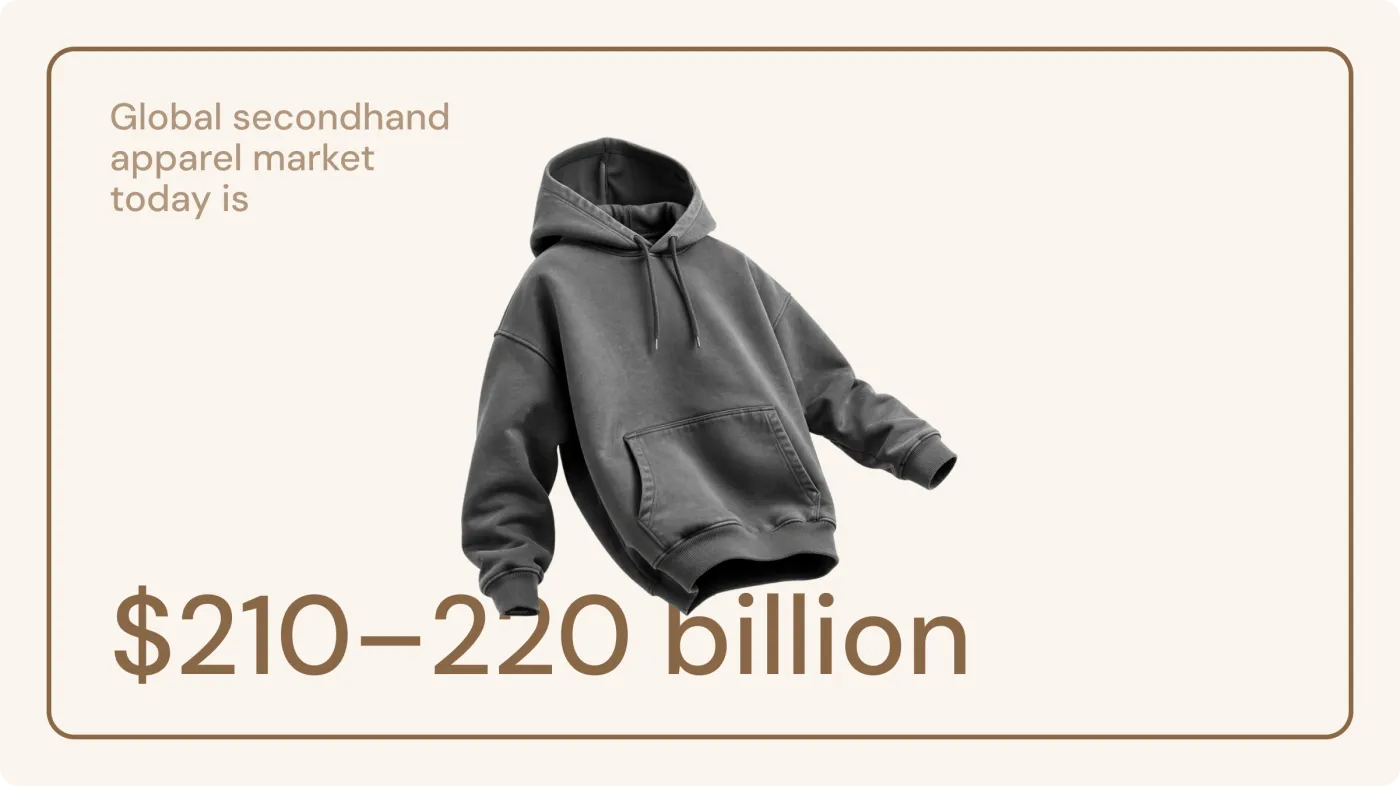
The global secondhand apparel market is $210–220 billion today. It will reach $320–360 billion by 2030 (BCG × Vestiaire Collective, 2025). In the U.S. alone, branded resale — resale run directly by the brand — hit $30 billion in 2025, growing 13% year over year. That is four times faster than new apparel retail.
The question is no longer whether to do branded resale. The question is how long you can afford to delay.
What Is Branded Resale?
Branded resale (also called recommerce or brand-managed resale) is when a brand operates its own secondhand marketplace or trade-in program — under its own name, on its own platform, with control over pricing, presentation, and customer data.
This is different from selling through Vestiaire Collective or ThredUp. In those channels, your products are resold, but you receive no revenue, no customer data, and no brand lift. Another company profits from your brand equity.
In branded resale, you own the channel. You set the rules. You keep the margin.
Three common formats:
- Peer-to-peer (P2P) marketplace. Customers list and sell their items directly to other customers through your branded storefront. The brand earns a commission on each sale. No inventory risk.
- Trade-in program. Customers return used items in exchange for store credit or cash. The brand takes ownership, reconditions the items, and resells them at a margin.
- Managed resale. The brand handles the full cycle: acquisition, authentication, grading, warehousing, and resale. Highest margin, highest operational complexity.
Most brands start with one model. Some run all three simultaneously.
Why 2026 Is the Inflection Point
- Consumer behavior has already shifted. 58% of U.S. consumers shopped secondhand in 2024, a record high and up 6 percentage points year over year (ThredUp 2025 Resale Report). 46% say: if they can find it secondhand, they will not buy it new. Among consumers under 35, that number reaches 55%. Resale is not a niche anymore. It is a primary shopping behavior for a significant portion of your customer base.
- The third-party platforms are capturing your upside. When your customers resell on Vinted or eBay, those platforms capture transaction fees, customer data, and brand exposure. The buyer's next purchase does not go to you — it goes wherever the platform sends them. Treet analyzed 250+ branded resale programs and found that 51% of resale shoppers are new to the brand. If resale is already happening, it is already acquiring customers. The only question is who captures that value.
- Profitability is proven. The "resale is a cost center" argument no longer holds. REI Re/Supply recorded 86% revenue growth year over year with its branded resale program. It doubled the business in five years and runs profitably. Patagonia's Worn Wear saw a 300% sales surge in one year. Portland Leather Goods generated $2M in resale revenue in 10 months, with a 259x ROI on platform cost. These are not edge cases. Across Treet's platform, the average brand sees 2–3x return on store credit issued, because customers who receive resale credit spend 375% of that credit amount on the main site.
- Regulation is coming. California's SB 707 (Extended Producer Responsibility law, effective 2028) requires brands selling 10,000+ units annually to fund end-of-life management for their products. The EU Ecodesign Regulation imposes similar requirements across Europe. Branded resale is the most commercially viable compliance path. It extends product life, reduces landfill, and generates revenue — instead of just generating cost.
What Brands Learn in Year One
Across early movers — REI, Patagonia, lululemon, Eileen Fisher, Dr. Martens, Tecovas, Fjallraven — several patterns repeat.
Resale customers are your best customers.
Archive Resale found that customers who shop both resale and full-price have 2–3x higher lifetime value than single-channel customers. Treet found that 89% of customers who sold through a brand's resale program subsequently purchased on the brand's main site. 77% of secondhand buyers also bought new in the same period.
Resale is not cannibalizing your primary business. It is deepening it.
New customer acquisition cost drops.
Faume found that acquisition via resale costs 40–60% less than classic digital campaigns. 70% of customers who purchased through a brand's resale program had never purchased from that brand before. This is consistent across all major platforms: 50–70% of resale shoppers are net-new to the brand.
At a time when paid acquisition costs are rising and iOS privacy changes have reduced targeting precision, resale is a structurally cheaper acquisition channel.
Store credit compounds.
When customers trade in products for store credit instead of cash, they spend significantly more than the credit amount. Tecovas saw 141% average additional spend over the credit amount. Portland Leather Goods saw 375%. The store credit mechanism turns a resale transaction into a sales driver.
Speed to launch matters more than perfection.
Tecovas launched its resale program in 32 days with no internal development resources. Within one week: $30,000 GMV. Within six months: $400,000+ in resale revenue, 112x ROI. The brands that waited to build a "perfect" solution consistently underperformed brands that launched fast and iterated.
The Most Common Objections
"Resale will cannibalize our new product sales."
The data says the opposite. Buyers of secondhand items typically could not afford the new price — or were not considering a purchase at all. Resale expands the addressable market, it does not shrink the existing one. Archive Resale found that 50% of resale shoppers were new to the brand entirely.
"We will damage our brand by selling secondhand."
The risk is greater if you do nothing. When your products appear on Vestiaire Collective or ThredUp in poor-quality listings, without authentication, without your editorial voice — that damages your brand. When you run the secondhand channel, you control how your products are presented at every stage.
Faume's clients in the luxury segment — Sandro, Isabel Marant, AMI Paris — found that a well-executed secondhand program reinforced product quality signals. Desirability in the secondhand market validates the original purchase.
"We do not have the operations for this."
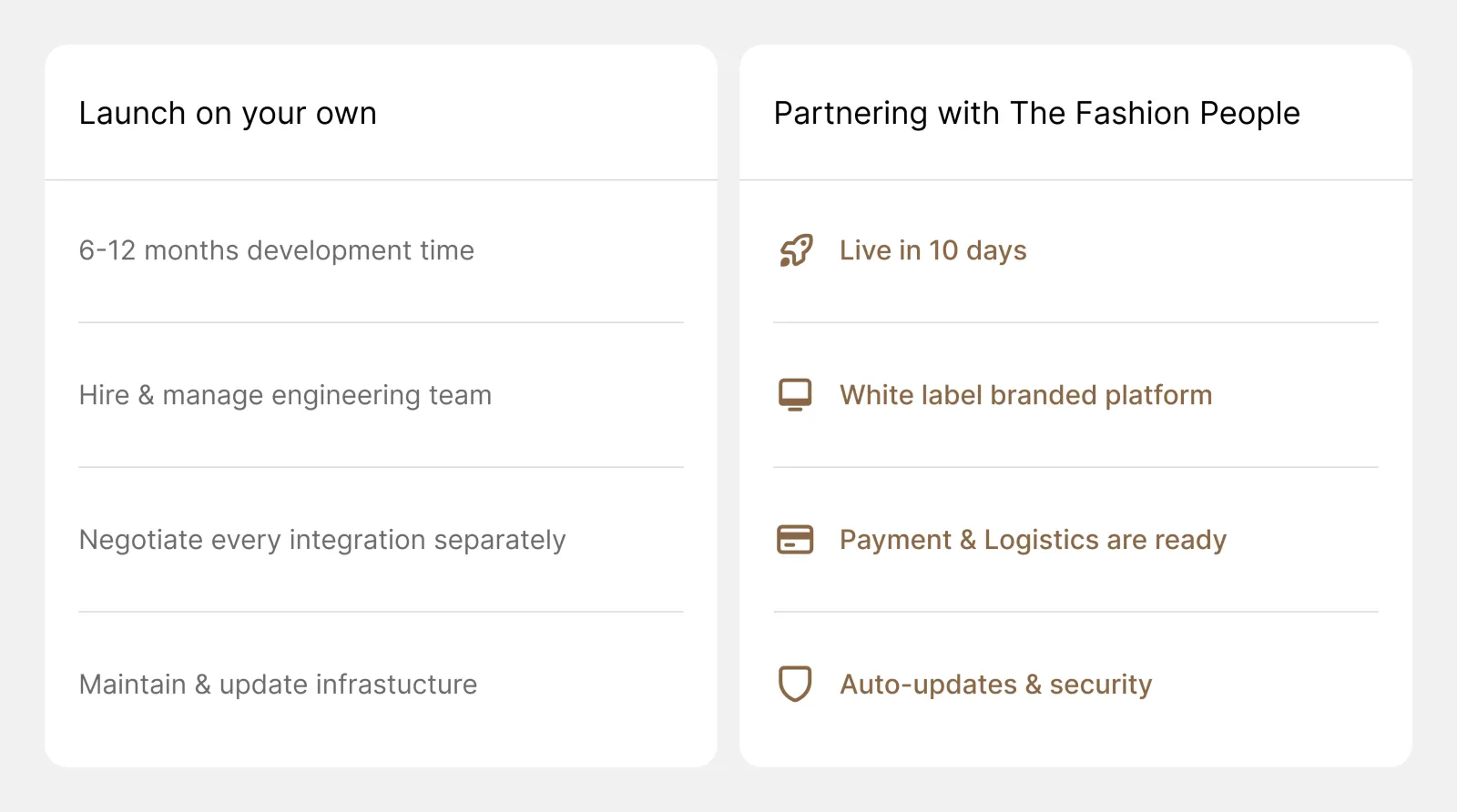
You do not need to. The platforms designed for branded resale handle logistics, authentication, pricing, customer support, and fulfillment. Treet's peer-to-peer model requires zero warehouse infrastructure from the brand. Archive built The North Face's full warehouse management system in two months, and its in-store trade-in app in six weeks.
How to Evaluate Your Readiness
Before choosing a platform or model, answer three questions:
- Do you have an existing resale market? Search your brand name on Depop, Vinted, eBay, and Poshmark. If you find active listings, your customers are already reselling. The question is how much of that transaction value you want to capture.
- What is your operational capacity? Brands with warehouses, returns processing, and retail footprints are better positioned for managed resale or trade-in. DTC brands with strong communities and no warehouse infrastructure should start with peer-to-peer.
- What do you want from resale? If the goal is new customer acquisition and brand loyalty, peer-to-peer with store credit is the most direct path. If the goal is margin on aged or returned inventory, managed resale or trade-in is more appropriate. Most mature programs run both.
Key Takeaways
- The global secondhand apparel market reaches $360B by 2030. Branded resale is growing at 13% per year in the U.S., four times faster than new apparel.
- 58% of U.S. consumers shopped secondhand in 2024. The behavior is mainstream, not niche.
- 50–70% of resale shoppers are net-new to the brand. Resale is a customer acquisition channel, not just a sustainability initiative.
- Acquisition cost via resale is 40–60% lower than paid digital (Faume data).
- Resale customers have 2–3x higher LTV than single-channel customers (Archive data).
- Store credit recipients spend 141–375% of their credit amount on subsequent purchases.
- California SB 707 and EU Ecodesign Regulation create compliance-driven demand for branded resale from 2028.
- Brands that launched fast outperformed brands that waited to build the perfect solution.