Introduction
Branded resale is often sold on sustainability. Brands announce their secondhand programs with press releases about circularity and carbon avoidance. The actual business case — revenue, margin, customer lifetime value — gets buried in the fine print.
This article extracts the numbers. From 20+ published case studies and platform data reports, here is what branded resale programs actually return, across five business dimensions.
A caveat upfront: most platforms do not publish results for underperforming programs. The data below reflects programs that published results, which skews toward strong performers. Use these figures as directional benchmarks, not guarantees.
Dimension 1: Revenue
Portland Leather Goods generated $2M in 10 months (Treet). Tecovas hit $400K+ in 6 months. REI Re/Supply grew 86% YOY and is profitable. ba&sh's secondhand channel represents 5% of French revenue (€1M+ annually).
The primary driver: store credit. When sellers receive brand credit instead of cash, disbursement rates and subsequent spend both increase — creating a self-reinforcing cycle between resale supply and primary-channel demand.
Dimension 2: Return on Investment
Portland Leather Goods: 259x ROI on platform cost. Tecovas: 112x in 6 months. Treet reports average platform cost recovery in under 30 days for active programs.
ROI has two components: direct resale margin (10–25% commission in P2P, 40–80% in managed) and downstream spend from store credit (customers spend 141–375% of their credit amount on the primary site). A $50 credit generates $70–$187 in additional revenue. Most published ROI figures exclude downstream spend, which means real ROI is materially higher than the headline numbers.
Dimension 3: New Customer Acquisition
50–70% of resale buyers are new to the brand. This is consistent across every platform: 51% (Treet), 50% (Archive), 70% (Faume), 50–65% (Trove). Resale is a customer acquisition channel, not just a loyalty program.
Acquisition cost via resale is 40–60% lower than paid digital campaigns (Faume). For brands spending $50–$150 per new customer through paid channels, resale acquires at $20–$60 per head — and those customers are pre-qualified through brand alignment.
89% of customers who sold through a brand's P2P platform subsequently purchased on the main site (Treet). 77% of secondhand buyers also bought new. This is not substitution — it is an entry-point effect. Resale introduces customers at a lower price point, and a significant portion convert to full-price buyers over time.
Dimension 4: Customer Lifetime Value
Customers who shop both resale and full-price have 2–3x higher LTV than single-channel customers (Archive). 50% of resale platform revenue comes from repeat customers who represent only 25% of the customer base — repeat resale buyers are disproportionately valuable.
Store credit is the highest-leverage mechanism. 84% of customers choose credit over cash (Treet). They spend 141–375% of the credit amount on the primary site. Tecovas sellers who chose credit had 70% higher AOV than average. Portland Leather Goods: $50 credit generated $187 in additional revenue.
The implication: trade-in programs are not just inventory recovery. They are structured revenue drivers for the primary channel.
Dimension 5: Sustainability and Compliance Value
Across platforms, branded resale programs report 25% CO2 reduction per item resold (Treet), 13M kg CO2e avoided in 2025 (Archive), and 650,000+ lbs diverted from landfills. These metrics matter commercially: California SB 707 (effective 2028) requires brands selling 10,000+ units annually to fund end-of-life management. The EU Ecodesign Regulation imposes similar requirements.
Brands running active resale programs can document compliance through program data rather than paying into external schemes. For brands with significant CA or EU revenue, avoided compliance cost is a legitimate line item in the ROI calculation.
What to Watch For
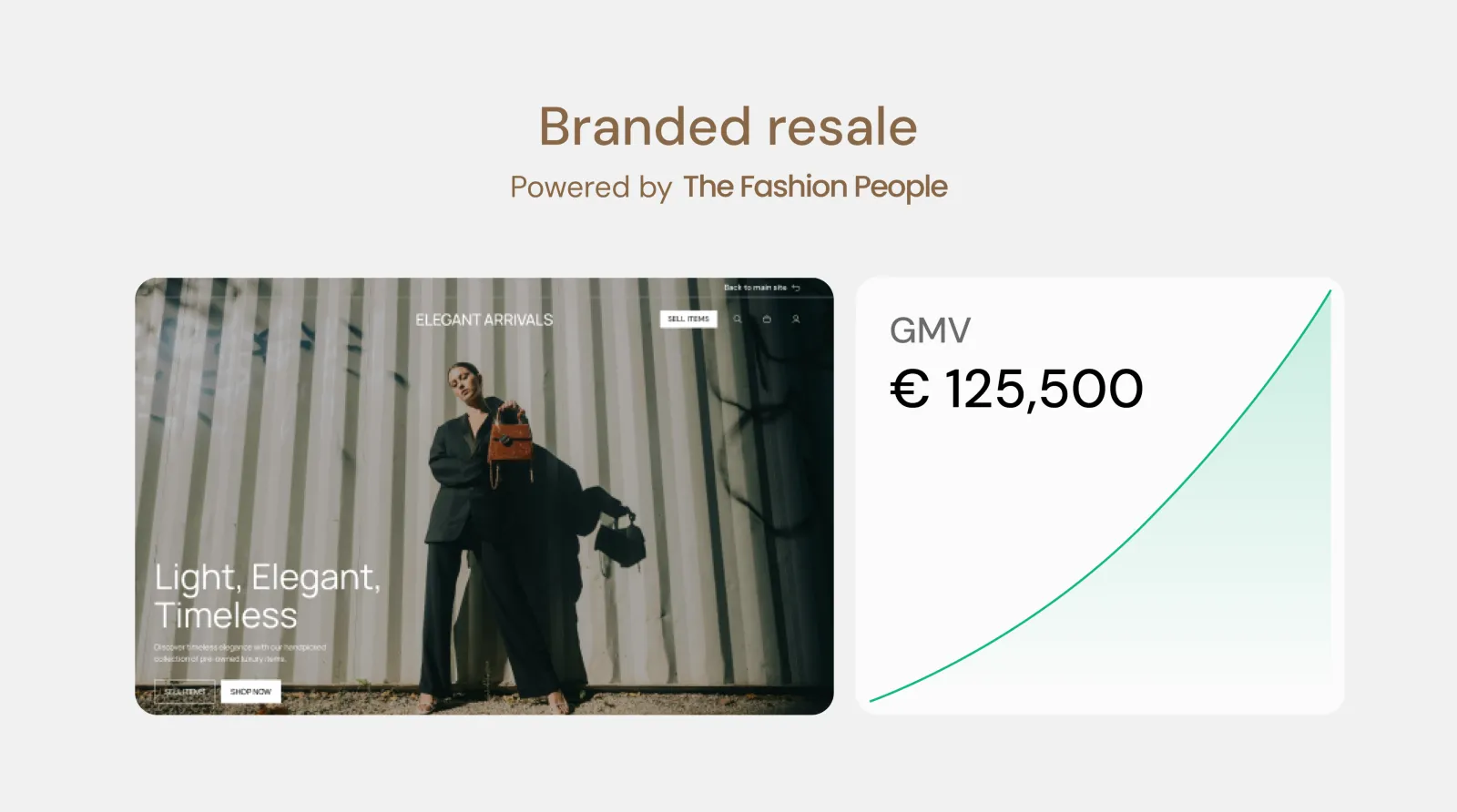
Realistic benchmarks for a mid-market brand (50K–500K annual orders) in the first 6 months:
- $30K–$150K/month GMV
- 40–60% sell-through
- 50–70x ROI on platform cost
- 40–60% of buyers are new customers
The three most common drivers of underperformance:
- Insufficient seller acquisition — brands that wait for organic traffic underperform
- Wrong category — commodity/fast-fashion has low resale desirability
- Low discoverability — a header link to resale increases purchases by 109%
A caveat: published case studies skew toward strong performers. Most platforms do not publish underperforming programs. Use these figures as directional benchmarks, not guarantees.
Key Takeaways
Revenue & ROI:
- Published ROI from branded resale programs: 112x (Tecovas, 6 months) to 259x (Portland Leather Goods, 10 months) — these are top-performer benchmarks.
Customer Acquisition:
- 50–70% of resale shoppers are net-new to the brand across all major platforms.
- Acquisition cost via resale is 40–60% lower than paid digital campaigns
- 89% of sellers subsequently purchase on the main site.
Customer Lifetime Value:
- Resale customers have 2–3x higher LTV than single-channel customers.
- Store credit recipients spend 141–375% of their credit amount on subsequent purchases.
Compliance Value:
- Sustainability data (CO2 avoided, waste diverted) is commercially relevant for SB 707 and EU Ecodesign Regulation compliance from 2028.
Success Factors:
- A header link to the resale program on the main site increases monthly purchases by 109%.
- Top three drivers of underperformance: insufficient seller acquisition, wrong model for category, low storefront discoverability.