Introduction
Every branded resale program runs on one of two operational models: peer-to-peer or managed. Sometimes both.
The model you choose determines your inventory risk, your margin structure, your operational complexity, and your time to revenue. Choosing the wrong model does not necessarily mean failure, but it often means spending 12 months building infrastructure before you see meaningful revenue.
This article breaks down both models, what each requires from your team, and the decision criteria that determine which fits your brand.
The Two Core Models Defined
Peer-to-peer (P2P) resale is a customer-to-customer marketplace, run under your brand. A customer lists a used item from your brand on your platform. Another customer buys it. The transaction happens between them. You earn a commission (typically 10–25% of sale price) on each transaction.
You never touch the inventory. No warehouse. No reconditioning. No returns to process.
Managed resale is a brand-operated secondhand retail channel. You (or your platform partner) physically receive used items from customers through a trade-in or take-back program. You authenticate them, assess condition, recondition if needed, set prices, and sell them as certified pre-owned.
You own the inventory. You control the margin. You also absorb the operational complexity.
Trade-in programs are a variant of managed resale. The mechanism is the same — customer sends in item, brand takes ownership — but the focus is on the exchange: the customer receives store credit or cash in return, and the item enters your resale inventory.
| Peer-to-peer | Managed / Trade-In | |
|---|---|---|
| Inventory ownership | None | Yes |
| Warehouse required | No | Yes (or outsourced) |
| Time to launch | 1-4 weeks | 4-12 weeks |
| Margin per item | Commission (10-25%) | Full retail spread (40-70%) |
| Revenue predictability | Lower (depends on seller activity) | Higher (you control inventory) |
| Operational complexity | Low | High |
| Best for | DTC brands, community-driven brands, low inventory risk preference | Brands with returns infrastructure, large retail footprints, aged inventory |
| Primary use case | Customer acquisition, brand loyalty, community | Inventory recovery, margin on returns, sustainability compliance |
Peer-to-Peer Resale: What It Looks Like in Practice
P2P is the default starting point for most DTC and mid-market brands. The mechanics are straightforward: you provide the storefront and brand experience, your customers provide the inventory.
How it works, step by step:
- A seller (your existing customer) registers on your branded resale platform and submits a listing.
- Your platform (or your team, for authentication-heavy categories) reviews and approves the listing.
- The item goes live on your branded storefront.
- A buyer purchases it.
- The seller ships directly to the buyer. Or the platform facilitates.
- Your platform disbursements the seller's earnings (cash or store credit). You keep your commission.
What you need internally:
For most DTC brands running on Shopify with a platform like Treet or Archive, the internal requirements are minimal: a product manager to oversee the program, a marketing function to drive seller acquisition, and a customer support team for exceptions. No warehouse team. No reverse logistics.
What drives performance:
P2P resale lives and dies on seller supply. Without listings, there is nothing to buy. The most effective acquisition lever is store credit: when customers receive credit instead of cash, disbursement rates are higher (84% of sellers choose store credit on Treet) and subsequent purchases are significantly larger.
Automated marketing — email campaigns, listing reminders, buyer matching — drives a measurable share of revenue. Treet's automated marketing engine drives over 25% of sales on the platform.
Who it fits:
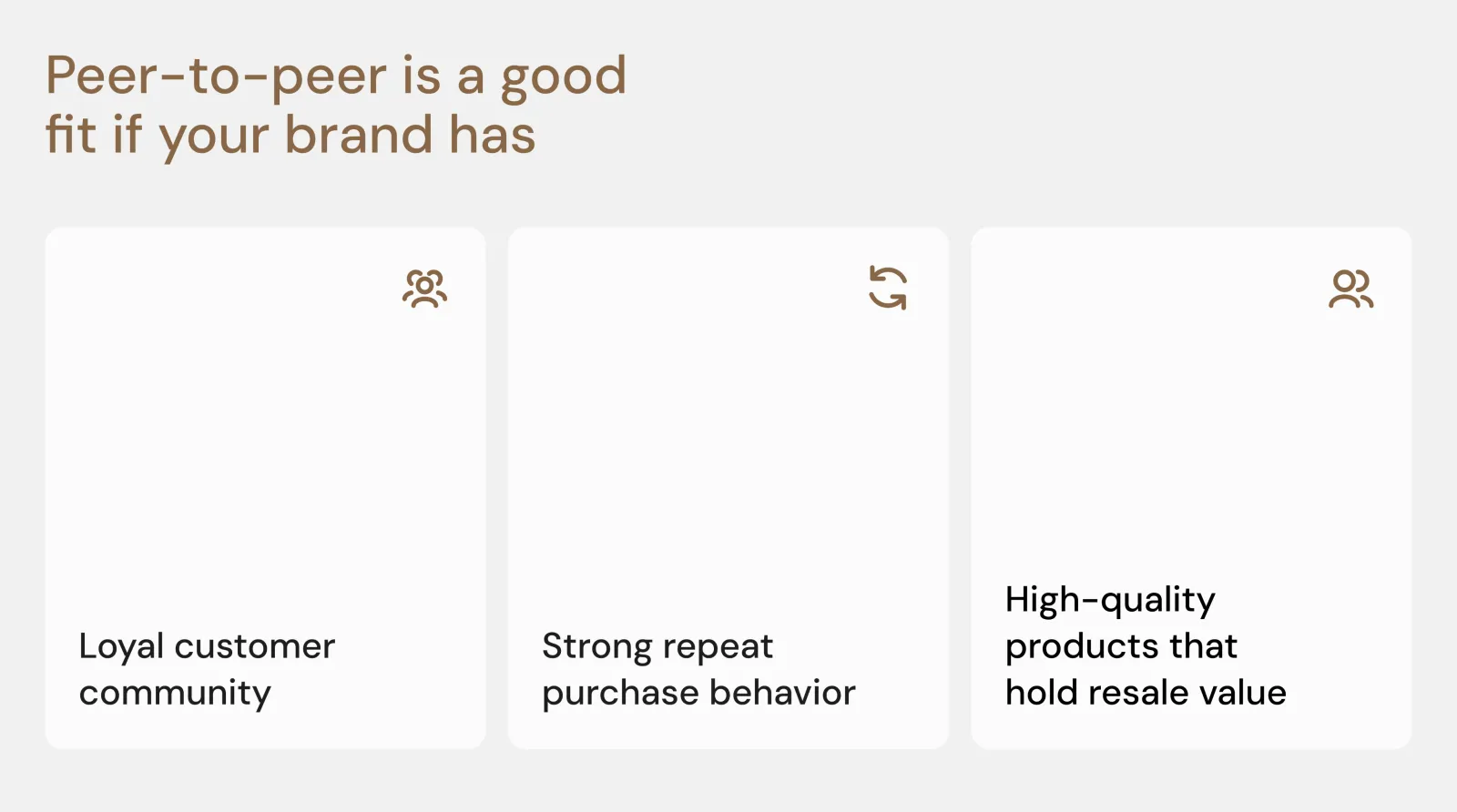
P2P is the right model if your brand has a loyal customer community, strong repeat purchase behavior, and high-quality products that hold resale value. Categories that work well: denim, footwear, outerwear, leather goods, performance apparel, children's clothing. Categories that struggle: fast fashion, low-quality basics, anything where resale value drops faster than the cost of listing.
Minimum viable scale: 5,000 monthly site visitors (Treet's published benchmark). Below that, the marketplace may not generate enough liquidity to sustain itself.
Case study: Tecovas Trading Post:
- Launched in 32 days, zero internal development.
- $400,000+ resale revenue in 6 months.
- 62% of sellers chose store credit. Average additional spend: 141% of credit amount.
Managed Resale: What It Looks Like in Practice
Managed resale is a more complex operation, but it returns more per item. You control pricing, presentation, and authentication. Margins on secondhand items run 40–80% of original retail price — often higher than margins on new product, because the acquisition cost (trade-in value) is lower than manufacturing cost.
How it works, step by step:
- A customer initiates a trade-in through your website or in-store.
- They ship the item (or drop it off) and receive a quote.
- Your team (or platform partner) receives the item, authenticates it, assesses condition, and routes it: sell, recondition, donate, or recycle.
- Accepted items enter your resale inventory at a dynamic price.
- Items are listed on your branded storefront and sold.
- You fulfill directly to the buyer.
What you need internally:
Managed resale requires operational infrastructure: warehouse space (or a 3PL partner), a reconditioning workflow, and a pricing function. For brands already processing significant return volumes, much of this infrastructure may already exist.
The platforms designed for managed resale (Trove, Archive, Faume) provide the WMS, dynamic pricing engine, and reconditioning workflow. Your team provides the physical space and staff, or outsources to their logistics partners.
What drives performance:
Dynamic pricing is the primary lever for managed resale profitability. Items that sit in inventory longer need price reductions. Archive's pricing engine automatically reduces price 10% after 10 days, then 10% every 7 days until sold or a floor price is reached. Items that would sell below the floor are routed to clearance or donated.
AI-assisted grading and condition assessment reduces labor cost significantly. Trove reports up to 40% reduction in labor costs through AI workflows.
In-store trade-in with immediate store credit creates a powerful flywheel: Trove's in-store programs show that 31% of store credit is redeemed same-day, with a 50%+ lift on gift card value issued.
Who it fits:
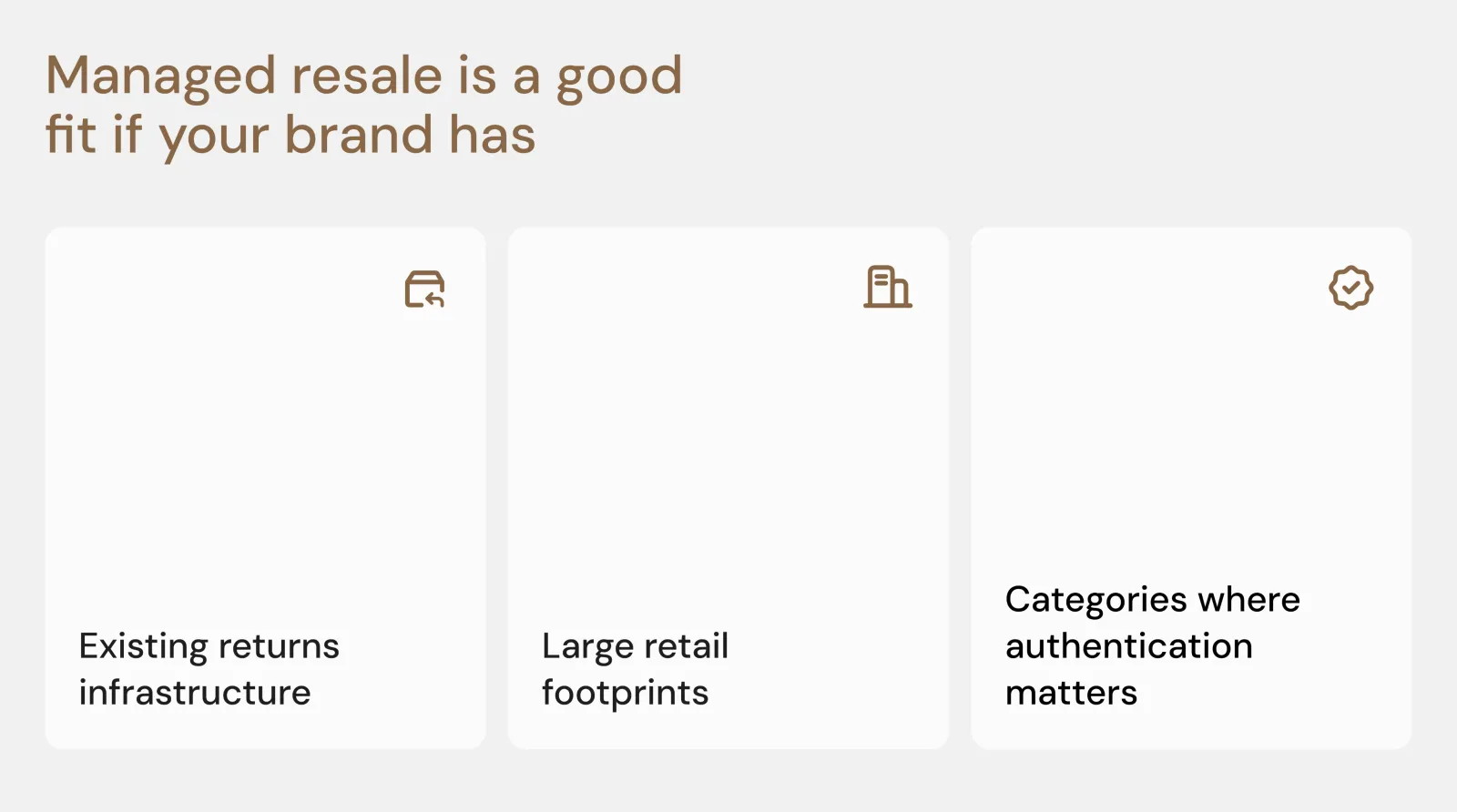
Managed resale works best for brands with existing returns infrastructure, large retail footprints, and categories where authentication matters. Outdoor gear, performance apparel, footwear, luxury accessories — categories where condition grading is valuable and buyers are willing to pay a premium for certified pre-owned.
REI Re/Supply is the clearest proof of scale: 86% YOY revenue growth, profitable, with trade-in across hundreds of locations. The North Face Renewed processed 72,000+ items through Archive's WMS in the first 6 months, and the resale channel is on track to represent 10%+ of total brand revenue.
Case study: The North Face Renewed (Archive):
- WMS built in 2 months. In-store trade-in app built in 6 weeks.
- Deployed to 105 U.S. and Canadian stores.
- 72,000+ items processed in first 6 months.
- Resale channel on track to represent 10%+ of total brand revenue.
Running Both Models: The Hybrid Approach
Most mature resale programs run both models simultaneously, targeting different use cases.
P2P handles high-volume, lower-touch resale across the full catalog. Managed resale handles authentication-heavy categories, higher-value items, and trade-in programs tied to in-store retail.
lululemon Like New (Archive) runs both: P2P for community-driven resale and managed resale for certified reconditioning of trade-in items. Fjallraven Preloved runs a similar hybrid with separate storefronts for P2P and brand-managed inventory.
The operational ceiling for running both is higher, but the ceiling for revenue and customer engagement is also higher. Brands that combine P2P and managed resale consistently outperform brands running a single model.
How platforms solve the complexity problem. The technical infrastructure for branded resale — listing review, payment processing, shipping coordination, customer support, payouts — is identical across brands. Platforms like Treet, Archive, and Trove handle this layer so brands can focus on the customer-facing experience and merchandising.
The Decision Framework
Answer these five questions to determine your starting point.
- Do you have a warehouse or returns processing infrastructure? Yes: Managed resale or trade-in is viable. No: Start with P2P.
- How quickly do you need to show revenue? Within 30 days: P2P. Within 90 days: either. Building long-term infrastructure: managed.
- Is authentication important in your category? Luxury, outdoor gear, footwear, high-value apparel: managed resale with authentication is necessary for buyer trust and margin protection. Basics and mid-market fashion: P2P is sufficient.
- What is your primary goal? New customer acquisition and community engagement: P2P. Margin recovery on returns and aged inventory: managed / trade-in. Both: start P2P, add managed in year two.
- What is your brand's community size? Above 50,000 monthly site visitors: both models are viable from day one. 10,000–50,000: start P2P, add managed when inventory supply is stable. Below 10,000: validate with P2P before committing to managed infrastructure.
Key Takeaways
- Peer-to-peer resale requires no inventory ownership, launches in 1–4 weeks, and earns 10–25% commission per sale. Best for DTC brands with strong communities.
- Managed resale requires physical infrastructure, takes 4–12 weeks to launch, but returns 40–80% margin. Best for brands with existing returns operations.
- The primary lever in P2P is seller supply — driven by store credit incentives and automated marketing.
- The primary lever in managed resale is dynamic pricing and AI-assisted grading — which reduce inventory carrying cost and labor.
- 84% of P2P sellers choose store credit over cash (Treet). Store credit recipients spend 141–375% of their credit amount on subsequent purchases.
- Most mature resale programs run both models. Start with P2P. Add managed when supply and demand are validated.
- The decision is not binary. The right question is: which model do you start with?